Day six, we arrived at Thyangboche as it started to snow! I hadn’t expected it to be this cold as it was technically Spring. Snow isn’t ideal conditions when you’re in sneakers but it was SO pretty. I’ve never been in proper snow before unless you count the couple of millimeters that fell on my balcony in Wellington two years ago.
SNOW
There is also an incredible monastery up in the mountains, it's the home of the Rimpoche of Tengboche and the four of us were able to have the experience of sitting in on a two hour ceremony. Obviously it wasn't in English, but you could grasp what was happening. I'm not buddhist but it was still an honour to have yet another experience I couldn't have imagined, plus since I hadn't really read the itinerary it was a surprise!
3867m in Nepal's spiritual center of Tibetan Buddhism (no pics inside allowed)
At this altitude I was starting to get mild headaches but the altitude sickness was nothing like some of the other trekkers that we met. A few were seriously unwell and one guy decided to turn back. The only thing with the height that bothered me was the cold. Since I’m neither outdoorsy nor do I live in a cold city I had to purchase a fair amount of gear, from my pack to clothing to walking sticks to metal drink bottles, and as the trip was last minute I hadn’t been saving and didn’t have time to shop around or wait for sales so I was trying to limit my spending. I decided that instead of spending $150+ on a sleeping bag I’d use the one at home. If I had throughly read my packing list I’d have known I required a four season bag that was comfortable at -10°C … My bag was three seasons, none of which were winter! Waking up to ice on the inside of our cabin was all part of the adventure. I can honestly say that I considered attempting the remainder of the trek in my (pitiful) sleeping bag.
2 pair socks, 3 pair pants, 4 top half layers, puffer jacket, neck warmer, beanie & 2 hot water bottles
a pony that came to frolic in the snow with Karen & I
The next day, was one of the most beautiful walk’s of the trek, it was no longer snowing but we left quite early in the morning to avoid the other groups, and the resulting mud from the melting snow. I think this was the day that we saw quite a few other people, it wasn’t as crowded as it can get in the peak season though. The hike was chilly but not freezing as the snow had stopped falling. Our group had a few laughs with whacking snow laden overhanging tree branches so the snow dumped on each other. Admittedly I did muck it up and managed to get myself once! Didn’t make that mistake again! ..or did I? :-(
PART TWO: The morning of our “rest day” we were to go and see the National Park Museum at the top of a hill behind Namche Bazaar at the break of dawn... Before you get to the actual path there are a few stairs. Definitely my most challenging steps of the whole EBC trek. It was early morning, pre pancakes, –we'd had a huge day prior, (more exercise than I do in a month squished into a day) and I was puffed by the 50th 6th step. Fortunately, against all odds I survived and lived to watch a gorgeous sunrise up over stunning snowy peaks.
The following day we headed to Khumjung, on the way we viewed the Kunde Hospital built by our very own Sir Ed! Further a long
the track is a school, also founded by him! It’s always awesome to be so far
from home and to be blessed with opportunities be reminded of the incredible
Kiwis that NZ’s produced! The school was built back in ’61, it was only a
couple of classrooms back then but now it has nearly 400 pupils! The yeti skull (or scalp) displayed at Khumjung Monastery was a legitimate disappointment, I was well aware that yeti's aren't actually real, but somehow in my oxygenhotshowersleep deprived state I was expecting to see the bones of a monsters skull. Khumjung was a pretty chilled little village, we saw BABY YAKS, and the lodge was really quaint, it was the first time I was cold enough in the common room to get excited by the addition of dried yak dung being added to the fire. In the lodges/ tea houses that we stayed at along the trek there is a dining area and in the centre is a large pot bellied fire for heating. The yak dung stinks, but when it was that cold I was ready to go collect more poo and add it to the fire myself!
Boy playing at the Khumjung school
In the late afternoons after the days walk we usually hung out as a group, to be honest it was all rather tame and not at all like my Contiki tour though Europe (I didn't that the trek would be overly similar to the Contiki, but I had hoped for the occasional themed dance party) Totally different story, turns out due to the altitude you can't drink alcohol at all, incidentally after all that walking and fresh air we were so tired that dinner was at 6pm sharp. The food was pretty terrible, the tea houses steamed their pizzas (yup, that makes them soggy) and as wood/gas are limited most of the food seemed a tad undercooked, my trick was just to get it down as quickly as possible before my poor tastebuds had a chance to notice what was happening! Food (even after we'd just eaten) was the main topic of discussion, quite torturous really. Prior to the trek I'd expected late nights, the reality was the four of us sneaking hopeful glances at the clock waiting until it hit 7pm- the earliest we felt we could fall into bed without feeling too geriatric!
PART ONE: One month ago today, after ten days of trekking I
arrived at Mt Everest Base Camp. For me, it’s probably one of my bigger life
achievements and something on my “Bucket-list” I never really thought I was
capable of ticking off. In all honesty, I’m not really that much of an outdoorsy
person, and in the rush to book flights, insurance, pack up my flat and say
goodbye to my friends I didn’t really take the time to investigate just how
physically demanding a trek EBC is. It wasn’t until the tour company (Gecko)
wanted me to sign a form committing to a three month training plan (I only had
a few days between deciding to do the trek and leaving NZ) and asking about my
previous hiking experience that I started to get a little nervous. You see, I’m
not really into hills… I attended
Victoria University for three years and probably walked up that hill less than
10 times, always opting for the $2 bus that took ten minutes longer than
walking did. The only hiking experience I could boast to Gecko about was the 6
hour Tongariro Crossing I’d walked 14 months previously. To say I was unprepared
is an understatement; I trekked to Base Camp trek in four-year-old running shoes. That’s
right, 140+kms in sneakers with very little tread and zero ankle support. It
snowed, which then melted and turned into extra slippery mud. Waterproof hiking
boots maybe have been more suited to the terrain but then it would have been
less of a challenge :-D
As I’m not the best with directions and occasionally get lost driving the eights minutes to work in my hometown, and I
decided to do EBC with a tour group, Gecko had the best deal at the time and
they turned out to be pretty fantastic. There were four of us (me, and three
Aussies), one guide Tekay and our sherpa, Mingmar who was truly awesome!
Me, Karen, Mingmar, Hugh, Tekay and Jack
The group met in Kathmandu for a group dinner and
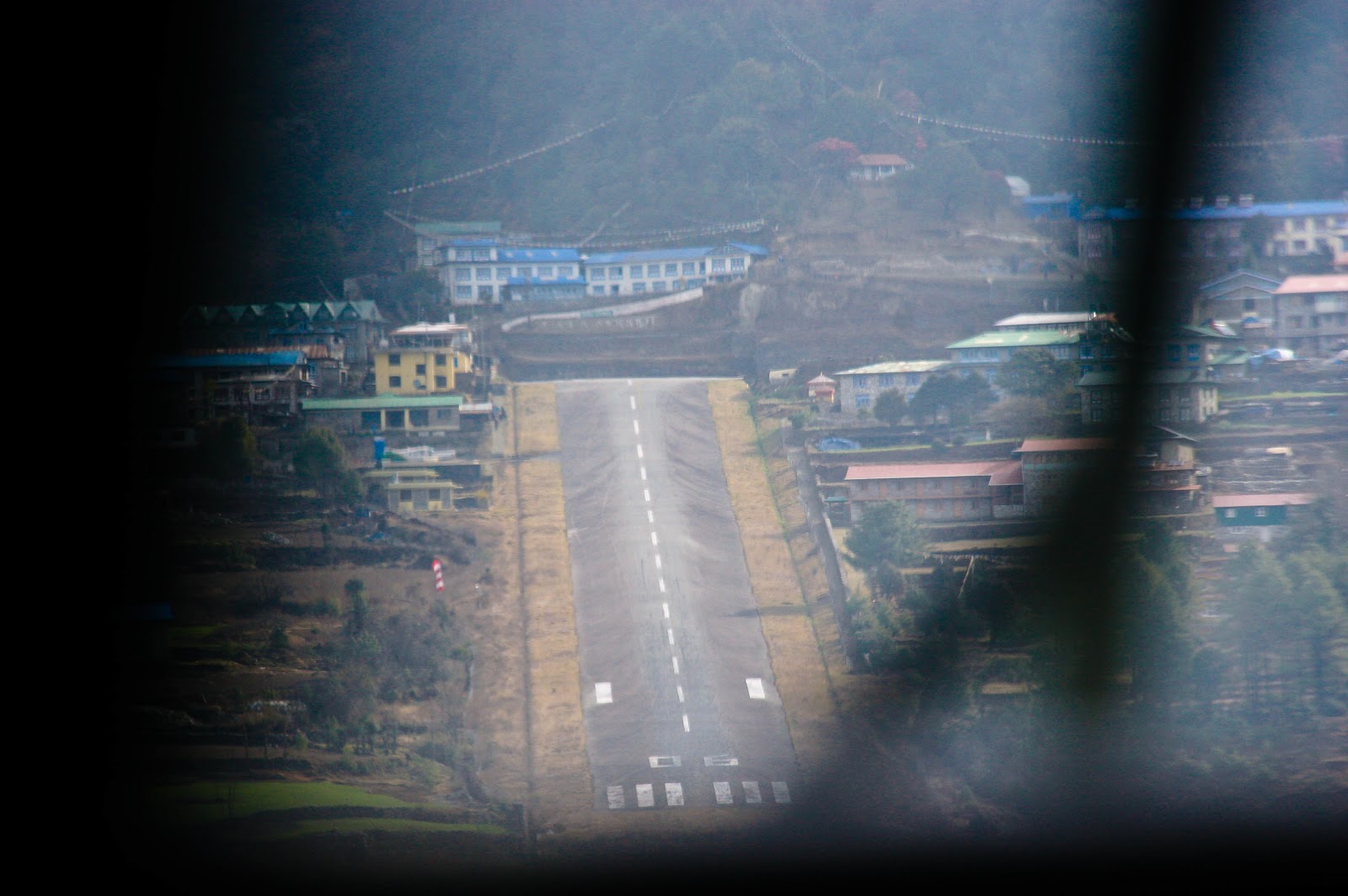
left early the next morning for our flight to Lukla; the world’s most dangerous
airport. The runway is a mere 460 by 20m with a 12% gradient – that’s quite a
slope and there’s no room for error, it’s a short runway with a stone wall at
the end.
Looking through the cockpit windscreen at the very short and steep runway.
Fortunately the landing was smooth and after
breakfast we set off. It was wonderful to escape the busy, loud and face-paced
city of Kathmandu for the quite mountains – no pollution, or car horns, just
the sounds of the river, the bells around the necks of the donkeys and dzo* and
the occasional cell phone! There’s reception for almost half of the trek.
Our first night on the mountain was in a lodge in
Phakding, and visited a beautiful monastery.
Prayer flags at the Phakding male monastery.
In hindsight I can now laugh at how Karen (my awesome room mate) and I thought it
was SO cold on our first night… I joked that I’d be sleeping in my puffer jacket by the end of the
trip! Little did I know that a mere five nights later in Dingboche I’d be sleeping in
thermal pants, tights, PJ pants, Jack’s track pants that he kindly lent me, 2
pairs of woolen trekking socks, a t-shirt, a long-sleeved polyprop, a polar
fleece jersey, that puffer jacket, gloves, a beanie, a buff (like a circle
scarf) with two aluminum drink bottles filled with boiling water, a sleeping
bag and a quilt!I also slept with my
camera batteries; torch, iPhone and iPod to prevent the cold from draining
their battery life.
On the second day of trekking we walked uphill for
six hours (it’s meant to take an average of eight but we’re awesome) and I got
my first real life look at Mt Everest! As a New Zealander I’ve heard a lot about
this mighty mountain, it was our Sir Edmund Hilary (andSherpa Norgay) that first reached the summit.
It looks truly majestic framed by evergreens, but it seems rather far away,
much further than I’d imagined, it’s also rather high up… It was a strange
moment of such excitement to see the mountain and an “oh sh*t” to realise how
far on foot I had to go!
Crossing a river on one of the many suspension bridges.
Arriving at Namche Bazaar was spectacular, not only because it was beautiful but because the next day was a rest day. The term “rest day” is actually very misleading, this one involved walking about 15km to a big white Buddhist monument, but you sleep at the same place in order to acclimatise.
Me at Namche Bazaar 3,500m above sea level, after the longest uphill walk of my life!
We decided to chill
and watch “Into Thin Air” a fantastic film but maybe something best viewed on the way back from Base Camp. After stocking up on necesites like chocolate, trekking poles (pink ones!), a buff and more chocolate we headed off to Khumjung!
The view from our room in Namche Bazaar
-->
*dzo
are half cow half yak , smaller than yaks with shorter here they are better at
handling the warmer climates at lower altitudes and it’s not until higher up in
the mountains that you see yaks.


.jpg)
.jpg)


.jpg)


.jpg)